Easy Crafts for KidsDIY Gifts
Homemade Playdough for Kids (3 Ingredients, 15 Minutes)
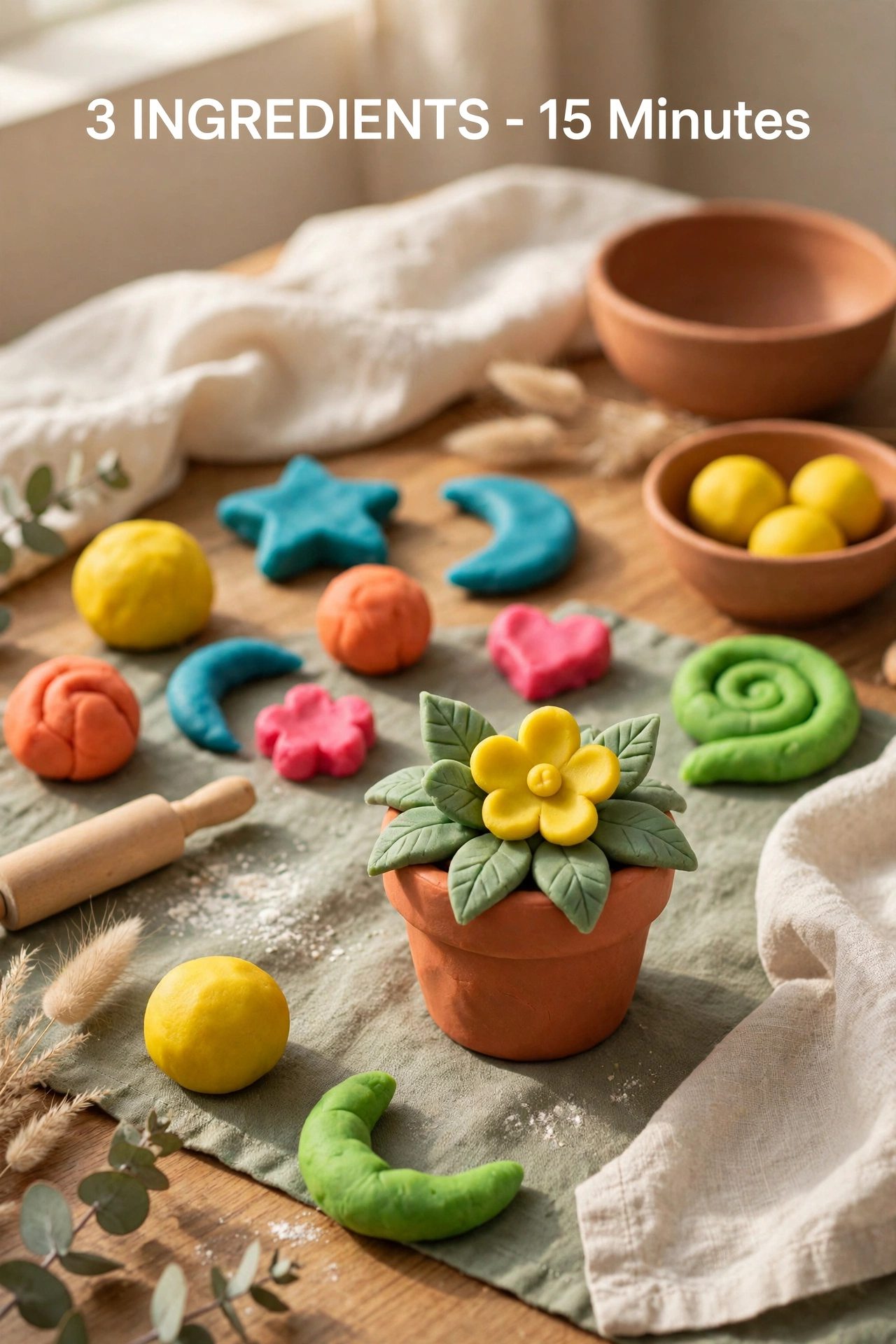
Illustration: the finished project as shown on Pinterest. Project images on this site are AI-generated illustrations — see our Editorial Policy.
The same playdough you saw on Pinterest, made at home in 15 minutes for under $5.
Homemade playdough is the cheapest kids’ craft there is, and it is also the one they play with longest. You mix flour, salt, and water, knead it for a few minutes, and you have soft, bright playdough for a fraction of the shop price. The whole project takes about 15 minutes, it costs under $5 for a big batch, and the ingredients are already in your kitchen. It is perfect for a rainy Saturday, a playdate, or a Christmas gift in a jar.
This is a good project for ages 2 to 8, because there is no cooking, no hot water, and nothing unsafe if a toddler tastes it, although it is very salty so they will not eat much. Younger kids can help stir and knead, older kids can mix their own colours and make shapes. One batch makes enough for three or four colours, and it keeps for weeks in a sealed tub.
How homemade playdough works
Flour gives the dough its body, salt stops it going sticky and helps it keep, and water brings it together. The ratio matters more than anything else: too much water makes it sticky, too little makes it crumbly. Start with the amounts below, then add water a spoonful at a time, kneading between each spoonful, until the dough is soft and smooth. Kneading is what makes it work, because it spreads the water evenly through the flour.
Food colouring gives the bright colours, and a spoonful of oil makes the dough softer and less likely to dry out. Cream of tartar is optional, but it makes the dough stretchier and helps it last longer. If you do not have it, the dough still works, it just dries out a little faster. Store it in an airtight tub or a sealed bag, and it stays soft for two to three weeks.
What you need
- Plain flour, 2 cups — about $1
- Table salt, 1 cup — about $1
- Warm water, 1 cup, added a little at a time — free
- Vegetable oil, 1 tablespoon — free, or about $1
- Food colouring, red, green, blue, and yellow — about $2
- A large bowl and a spoon — you have these
- Airtight tubs or zip bags, to store it — about $1
- Cookie cutters and rolling pins, to play with — you probably have these
Use plain flour, not self-raising flour, because self-raising flour has baking powder in it and makes the dough puffy and strange. Fine table salt works better than coarse salt, because it dissolves and makes a smoother dough. Gel food colouring gives brighter colours than liquid colouring, and you need less of it, so the dough stays drier.
Steps
- Mix the dry ingredients. Put the flour and salt in a large bowl and stir them together. If you are using cream of tartar, add 2 teaspoons now. Let the child stir, it is good practice for pouring and mixing.
- Add the oil and colour. Stir in the oil, then add a few drops of food colouring to the warm water in a jug. Start with one colour per batch, or make a plain batch first and colour it later. Stir the coloured water so the colour is even.
- Add the water slowly. Pour in half the water and stir with a spoon until it starts to come together. Then add the rest a spoonful at a time, stirring between each spoonful. Stop when the dough holds together in a ball and does not stick to the bowl.
- Knead it. Tip the dough onto a clean table and knead it for 3 to 5 minutes, pushing and folding it until it is smooth and soft. If it is sticky, add a pinch of flour. If it is crumbly, add a teaspoon of water and knead again.
- Make more colours. Divide the plain dough into three or four balls, flatten each one, add a few drops of a different colour, and knead until the colour is even. Wash your hands between colours, or the colours will mix into brown.
- Play. Roll it, cut it with cookie cutters, press it into shapes, and make animals, food, and Christmas trees. A rolling pin, a plastic knife, and a few jar lids are enough to keep kids busy for an hour.
- Store it. Put each colour in its own airtight tub or zip bag, and keep it at room temperature. If the dough dries out, knead in a few drops of water. If it goes sticky, knead in a pinch of flour.
Why homemade playdough goes wrong
Sticky dough usually means too much water, so add flour a pinch at a time and knead it in. Crumbly dough usually means too little water, so add water a teaspoon at a time. Dough that dries out in a day usually means it was left out in the air, so store it sealed, and add a spoonful of oil next time. Dough that smells bad after a week usually means it was stored wet or in a warm place, so throw it away and make a fresh batch, it only takes 15 minutes.
Cost breakdown
Flour $1, salt $1, food colouring $2. Total about $4 for a big batch in three or four colours, and under $1 per batch after that, because one bag of flour and one box of salt make many batches. A shop tub of playdough costs $3 to $5 for one small tub, so a homemade batch saves you $10 or more, and you know exactly what is in it.
Tips to save time and money
Make a double batch and give half away as a gift, in a small jar with a ribbon and a cookie cutter tied on top. It is a perfect teacher gift, stocking filler, or party favour. Keep a playdough kit ready: flour, salt, colouring, and tubs in one box, so you can start in five minutes. Let kids choose the colours, because a child who picked purple playdough will play with it longer than a child who was given red.
Common mistakes to avoid
Do not add all the water at once, because you cannot take it out again, and sticky dough is hard to fix. Do not use hot water, because it makes the dough gummy and it is not safe for small hands to knead. Do not leave playdough on carpet or fabric, because the colour can stain, play on a table or a tray instead. Do not store different colours touching each other, because they will blend into brown.
Variations to try
Try Christmas playdough: make red, green, and white dough, add a drop of peppermint or cinnamon scent, and give it with Christmas cookie cutters. Try glitter playdough: knead in a spoonful of fine glitter for a sparkly batch, best for older kids who will not put it in their mouths. Try scented playdough: add a drop of vanilla, lemon, or lavender oil for a calm, sensory batch. Try a playdough gift jar: layer three colours in a jar, tie on a cutter, and give it as a handmade gift.
Frequently asked questions
Is homemade playdough safe for toddlers? Yes, the ingredients are flour, salt, and water, so a taste will not harm them, although it is very salty. Watch toddlers so they do not eat a lot of it, and keep it away from babies who put everything in their mouths.
How long does it last? Two to three weeks in an airtight tub at room temperature, longer if you add cream of tartar and oil. If it dries out, knead in a few drops of water. If it smells bad or goes mouldy, throw it away.
Can I make it without food colouring? Yes, plain dough works just as well, and kids can paint their creations afterwards. You can also colour it naturally with cocoa powder for brown, turmeric for yellow, or beetroot juice for pink.
Why is my playdough sticky? Too much water, or not enough kneading. Add flour a pinch at a time and knead for a few more minutes. If it is still sticky, let it rest for 10 minutes, then knead again.